Showing posts with label Week 4. Show all posts

Sunday, October 18, 2020

Game Idea Research

First of all, during my research I have had the epiphany that we aren't so much making a fully fledged indie game as we are creating demos or Game Jam-esque builds. With this in mind I have decided to choose the Car game idea I presented in the last project blog post.

If I were to stick with the original concept from the original post I'd have to learn more about Unity especially about things like collisions, acceleration, momentum, etc. While these do seem like exciting challenges I also have to keep in mind my own ability in regards to the time constraint of the module. The original idea also insinuates the involvement of AI players/bots which could prove to be far more difficult than I originally considered. If by some way I am able to learn all of these things and am able to incorporate them all into my game it would have to be on a very basic level thus I would have to focus also on the level design of the game to bolster the basic mechanics. This would be to create a more fun and dynamic experience for players despite the rudimentary mechanics of the game itself. This currently seems like a scope that's a little out of my wheelhouse.
My evolution of this idea to make it more viable as a project for this module was to remove the active components of the world and lean more toward a sort of sandbox style game, thus kind of melding Idea 2 and Idea 4 from my last blog post into one game. Initially I had the idea to mould it into something more reminiscent of a game like Turbo Dismount or for a more nostalgic memory from my own heart Burnout 3: Takedown Crash Mode. I had the idea of developing it into a more Angry Birds style game with simple mechanics and a simple goal but with a lot of replay value. This idea also retains a lot of the game mechanics from the original idea just on a simpler, singleplayer scale. This sort of idea would also possibly let me incorporate things like power ups/effect pads which I researched here. The simpler mechanics of this game might also let me experiment with more level design or even other cosmetic elements such as Mesh Deformation.

My alternate idea for a demo sized game would be to fully amalgamate Idea 2 and Idea 4 and create a sandbox driving game similar to BeamNG.Drive or like the Sandbox mode in Besieged. This would allow me to explore a very wide range of game mechanics, even if they aren't exactly cohesive due to the open world nature of the game. I would also have the choice to experiment with the level design with different areas of the world exploring different game mechanics. This would motivate players to explore the game and would encourage replayability by having a range of options to interact with.

In terms of game mechanics I would have free reign to implement a plethora of things into the game such as having different areas explore different mechanics like fun power ups or even something like intricate manoeuvring. I would want to have a wide enough variety of options for different types of players to find something that they might like.

I could also implement a simple goal system by having a Main Challenge for each are which would reward the players for completing it. I would want these to be a mandatory yet enticing choice for player which would give the open world a sense of direction an challenge for players who aren't fond of 'aimless' sandboxes. This doesn't seem to hard to implement and would provide me with a direction for my level/world design also.

To encourage replayabilty and to add another sense of challenge to the game I could add Timer sections or have the choice for players to complete the challenges with a timer. This would add a pseudo challenge to the gameplay as players would only really be challenging themselves if they so choose but I feel like it would be effective in enticing exploration and replay. I would want this to be an optional feature in the world as I would still like for the game to be fun for a more casual player who wanted to focus on exploration without the looming challenge.

Thursday, October 15, 2020

Unity Tutorial 02

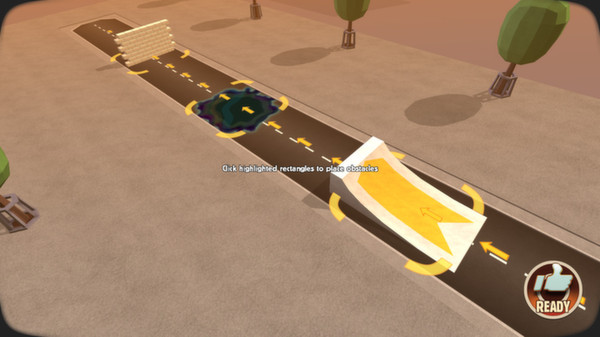
Unity screenshot of lesson 1.4

In this week's Unity lesson we added acceleration and reverse controls and steering and rotation to the car. Although the coding seemed complex and difficult initially, it followed a similar format for all the controls which made it easier to grasp. It was interesting seeing the premade code available in unity which helps to streamline and simplify the coding process for games. I found it fun to edit and experiment with the variables of the vehicle to find the right balance between forward speed and turn speed to make it feel intuitive and fluid.

The challenge part of the lesson was significantly more difficult than the first. I was able to make a fair guess with some of the tasks but was slightly off or completely lost with some of them. Honestly I realised that I had forgotten some of the basics and had to go back and review the earlier lessons for some things. Tasks such as changing the direction of the plane and it's speed as well as positioning the camera were simple enough but the tasks for steering and camera tracking proved to be far more difficult. For these I attempted to make the best guess I could but ended up looking for assistance after nothing worked as expected. This gave me insight into the coding side of Unity which I had forgotten. For the bonus tasks I had a fair guess as to how to do it and checking a online resources confirmed it which was an interesting thing to learn. With each line of code written it all makes a little more sense and I am starting to notice simple patterns which help make a lot more sense of all of it in my head.

Unity Screenshot of Challenge 1

Tuesday, October 13, 2020

Game Elements


In the first reading the author discuss how despite the vagueness of the definition of a 'game' there are a set of formal elements that can be found in most games that constitute them as a game, these included but were not limited to:

  • Rules
  • Conflict
  • Goals
  • Decision-making
  • An uncertain outcome
and also states that they should be:
  • Artificial
  • Voluntary
  • A simulation of some sort
  • An inefficient task
  • Considered an art
  • Be a closed system
The author then goes on to present a more concise list of these terms which they dub the Atomic Elements of Games which are:
    ● Players (Persons that participate in the game)
    ● Objectives (goals) (Things to do within/throughout the process of the game)
    ● Rules (Restrictions of the game system)
    ● Resources and Resource Management (All assets of the game and those which the player interacts                                                                         with)
    ● Game State (The state of everything at any point in time of a game (players, assets, etc.)
    ● Information (What information and the amount available to players throughout the game)
    ● Sequencing (The timing of the game e.g. turn based gameplay)
    ● Player Interaction (How the players interact with both each other and the game itself)
    ● Theme (Narrative, Backstory, Setting) 
    ● Games as Systems (The game should function as a closed system)

The author finally discusses both the process and importance of critical analysis and how it should be thorough and unbiased and should be used to gain understanding of a game and it's systems.


In the second academic reading titled "Game Design Research" published by Kultima Annakaisa the author discuss how in the field of Game/Games studies there is a disconnect between itself and general Design Research. It is then state that the basic interests of academic research can be broken into the three categories of games, gamers, and gaming. It is also stated that some academic study focuses instead on the interaction between players and games themselves and the context surrounding both.

It is stated that academic Game Studies dates to about 2001 and that initially there was debate on it requiring new academic processes due to it differing greatly from studies of existing fields of research.

It is conveyed that the field of Game Studies consists of researchers originating from a multitude of other disciplines. This led to a bias in Game Studies based on the beliefs and focuses of the researcher's original field. There was a observation of Game Studies possibly breaking off into sub-communities as a result of this but it was opposed by the point that no singular biases were causing such breaking off in contemporary game research. A data driven examination of the field revealed that there were indeed different clusters of academic papers and venues in Game Research that split into technical and non-technical study but it was also revealed that even within those groups there was still a wide variety of research interests.

The author reveals how there is debate within the field on how game design research should be conducted; whether it is strictly through the lens of a problem-solving activity or if it should be studied more similarly to General Design standards and frameworks.

It was also found that 'Game Design' as an academic term was used extremely loosely in research and was used to define a vague multitude of aspects. It was also found that Game Developers themselves also considered the term in widely differing contexts.

In the third reading, the authors discuss prototyping in the process of creating a game. The state that it is a great way to explore different primary aspects of a game such as it's space, mechanics, length, etc. The state that prototypes can range from extremely rudimentary such as basic physical(in their case paper) prototypes to more in depth working digital prototypes. They reveal that prototyping is used to help develop ideas and how it aids in the discovery and evolution process of a game.

Reading Task 10: Finishing touches

  Image by Markus Winkler on Unsplash.com For this week's reading task we, as a class, collectively worked on our individual sections in...